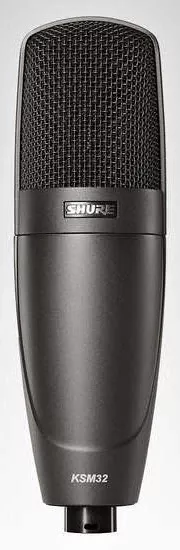
The KSM32 is a premium side-address cardioid condenser microphone for highly critical studio recording and live sound productions. With an extremely flat, extended frequency response, the KSM32 provides transparent reproduction of the original sound source. A 15 dB attenuation switch allows the KSM32 to handle the high sound pressure levels associated with drums, percussion, and ensembles. Comes with swivel mount and carrying case.
Features
- Class A, transformerless preamplifier circuitry eliminates cross-over distortion for improved linearity across the full frequency range.
- Embossed, high-compliance diaphragm provides extended low-frequency response.
- Ultra-thin, gold-layered, low-mass, Mylar® diaphragm for excellent transient response
- 15 dB attenuation switch for handling extremely high sound pressure levels (SPL)
- Switchable low-frequency filter provides greater flexibility to reduce background noise or to counteract proximity effect.
- Integrated three-stage pop protection grille reduces “pop” and other breath noise
- Internal shock mount reduces transmission of handling noise
- Replacement cartridge: RK374
- Extended frequency response
- Very low self-noise
- Exceptional low-frequency reproduction
- High output level
- High input SPL capability
- No cross-over distortion
- Extremely uniform polar response
- Superior common mode rejection and suppression of radio frequency interference
- Charcoal Gray finish
Applications
Some typical applications for the KSM32 are listed below. Microphone use, however, is a matter of personal taste. The KSM32 may be used for a variety of applications other than those listed.
- Voice — solo, background, voice-over, broadcasting
- Acoustic instruments — such as piano, guitar, drums, percussion, strings
- Wind instruments — brass and woodwind
- Low frequency instruments — such as double bass, electric bass, kick drum
- Overhead miking — drums or percussion
- Ensembles — choral or orchestral
- Room ambiance pick-up — guitar amplifier or drums
Both the acoustic environment and microphone placement have significant effects on the sound obtained when miking a source. You may need to experiment with these variables to achieve the best overall sound for each application.